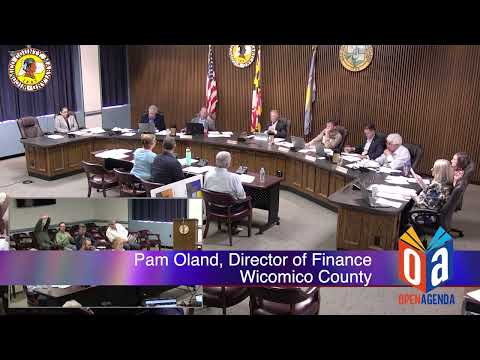
You're watching Open Agenda. Here's our
host, Joe White.
Welcome to Open Agenda. I'm your host,
Joe White. In today's episode, we're
going to talk about some of the updates
that you have not heard about the last
couple months while we've been busy
dealing with ICE, liquor bills, and even
landfill issues. So, in the studio with
me now is Mr. Trish Melvin from
Fruitland. Thank you, Mr. Jim Atkins
from Mardella.
>> Morning. So, the three of us have been
at just about every council meeting, or
at least one of the three of us have
been at every single one, the last uh
several months. And uh there's been a
lot of crisises that have come up in the
last six or seven months, maybe even 18
months. Lately, we've been dealing with
ice and liquor bills, and that's not
what this episode is necessarily about.
But why we've been talking about those
things, we haven't been talking about
the last couple crisis. Right.
>> Indeed. So, we we saw out in the council
meetings the last few months, hours long
of public comments centered around 287G.
We do know now that that's going to be
put on the back burner. Uh we'll talk
about that in another episode. However,
I want to bring in Mike Goldberg cuz
Mike has stayed right on top of this the
construction of Cell 7 or the lack
thereof. And Jim, I know you have stayed
on top of the dredging of the Wcom River
or the lack thereof.
>> Lack of. Yeah. Uh, and Trish, if you
would, uh, I'd like for you to come back
in because you have been there
specifically,
uh, for lots of reasons, but also mainly
for the 287G. So, I want to get your
perspective on what you haven't heard
about. So,
>> very good.
>> All right. So, stay with us. When we
come back, we're going to bring in Mike
Goldberg. We're going to talk about the
construction of Cell 7. So, stay with
us. We'll be right back.
Welcome back to Open Agenda. In the
studio with us now is Mike Goldberg from
Delmare.
>> Hey. Hey. Jim Atkins from Mardell.
>> Yes, sir.
>> So, gentlemen, we talked several shows
about the updates that we are expecting
to have at this meeting and and some of
the the policies have come up with
updates such as ice and liquor bills,
but we're still waiting on some answers
from some of the other crisises that the
counties had. And really, what I want to
talk in this segment about the updates
that we're still waiting on and and we
didn't make up these crisis. This is
stuff that's been brought to us by
elected officials. One example is the
construction of cell 7, the dredging of
the Wakcomo River, the funding of
Futland Primary, and the health
department's move into the Verizon
building that we now own without a lease
holder in place. So, I want to ask you
both, uh, do you have an expectation
that some of these very important and
very costly projects will be addressed
by the council and the county executive?
I'll let you start with cell 7.
>> Well, uh, with respect to cell 7, you
may recall that this was originally
supposed to go out for construction
bidding in, um, August, at the beginning
of August. Then, uh, somewhat after
that, uh, the, uh, now direct deputy
director of public works said that it
would go out for construction bidding in
October. And now here we are about to
enter the second week of November. And
as of this morning, it still was not on
the county's bid site. The uh for me,
there's a credibility issue here.
They've uh asserted that the
construction documents are 100%
complete, even though they bounced
around on the level of completion of the
documents, 60% 90%. So, but for at least
6 weeks now, they've been uh presented
as being 100% complete. There's
absolutely no reason that this could not
go out for construction bidding at with
100% [clears throat] documents. In fact,
had they if they were only 80% complete
documents, there's no reason that it
could not have gone out for construction
bidding and then you make negotiated
changes if there's some significant
change in the in the drawings. Now, when
we were told that the it would go out
for bid in August or even in the early
part of the fall, the expectation was
that construction would start in early
part of the winter, January, February,
weather permitting. And and that is a
major factor in this area that time of
year. That timeline put us into July for
completion, and that was a an aggressive
construction timeline. And our county
executive said that we were likely to
run out of landfill space before that
time. and that's is why she was going to
close the landfill two or even three
days a week at this point. So, the fact
that it's not out, there could be lots
of reasons. We've attended every
meeting. We haven't heard what those
reasons are and what's the expectation
now for the bidding or for the
construction phase. Right.
>> Well, that's correct. And you know the
uh the uh deputy director of public
works has asserted that you know this
will only be a 15-day construction
bidding period. I don't buy that either.
I have too much experience with
construction bids to even be you know
begin to believe that it will probably
take four perhaps as much as 6 weeks
before they review all of the bids. Um,
so almost anytime the administration is
making a statement about these
timelines, I've got to take it with an
an enormous grain of salt. Um, I can see
no plausible excuse for it not having
gone out to bid at at this juncture. Um,
the uh the only thing I can assume is
that there's some incompetence there.
The deputy director of public works
cannot do all of this by himself, but he
has an engineering manager who I don't I
cannot say with certainty, but I suspect
that she is involved with this.
>> And we have a highly paid cons uh
consultant and and this has come up with
the county executive. They're supposed
to do followup about these contracts,
but we we're paying a consultant whose
expertise lies in this. It's what's in
their contract.
>> It is. So, you know, it's it's kind of
like the Keystone Cops at this point,
near as I can tell. And I tell you, Joe,
I I even have to fundamentally question
whether or not there was actually a
crisis to start with. Was the
administration years late in getting
this process started? There's no
question about that. But was there
actually a crisis? Were we going to run
out of space before Cell 7 was
constructed? I don't know. And I have
reason to believe that we actually had a
sufficient reserve space to accommodate
the volume of trash. Now, we know that
the volume of trash has been reduced
somewhat, which would make sense by
prohibiting dumping of trash that's
originating from out of county. That
certainly helps, but their prior
estimates were that it was only about
15% the overall volume. So, it's that is
significant. Um but if there is a crisis
and the crisis now that was the um the
county executive's words that there is a
crisis uh but if there is one don't you
think that they would have you know
acted you know in a more timely manner
instead of you know instead of diddling
around as they apparently are.
>> So that was the crisis back in June and
July. Well, this this is the thing that
all in my opinion all this ties
together.
You take cell 7 and the landfill
all of a sudden after all the urgency
concern about getting cell 7 taken care
of and they supposedly
have reduced the amount of trash coming
in by limiting out of county people from
not being able to come in anymore.
There doesn't seem to be any followup
now on cell 7. Was that
>> it just kind of it's like poof magic is
taken care of.
>> Then you go down to dredging the
Wakamico River.
>> Now that was the crisis from April and
May.
>> That was a crisis. They had to have $2.3
million
and
the river the the dredge spoils had to
be moved
by October 1st. They had to have that
money or the Army Corps of Engineers
would kick us out of rotation again for
the fourth year now.
>> And they had to have it that night.
>> Yeah. Well, that day. Yes. Morning.
>> Yeah. That day. So, the council gave it
to them.
I've asked for the past two meetings for
information on on judging
uh because it's still not complete. the
the moving of the spoils is still not
complete. where they're going to move
them to is not complete.
But we have a private citizen
at the council meeting two weeks ago
come to the podium
who had contacted the Army Corps of
Engineers
and had been told by the Army Corps that
we were knocked out of rotation this
year because we had nowhere to to put
the the sludge that they dug up.
>> Yeah. and and and that was Joe Scafino
who's a contributor of the show.
>> Right. So,
you've got a private citizen coming to
tell the county council
that the Army Corps is not going to
judge the river this year. Why is the
executive or the county council not
aware of that before a private citizen
comes up and tells them?
>> Well, they could be aware of it. They're
just not
>> and not telling anybody. My whole
problem with the council, the more I'm
around it,
is
there is never any followup on anything.
They talk about something, they make a
decision, they give the go ahead to to
to start this, but there's no followup.
Another of the questions that I've asked
and not gotten an answer is if the
judge material had to be moved out of
Sharp's Point by October 1st and they
bid it out on a contract. Was there a
penalty phase in that contract if the
contractor did not complete his job?
>> The job was not complete. Look, I don't
know if there's a penalty contract or
not because I've not I've never gotten
an answer. And and then you go to to
your comment Tuesday night about the
Verizon building and the health
department
>> and that was the crisis from a year
before. We needed we needed to have a
place for the health department to move
to.
>> Yes. And you know then then in the
budget in June
was it
>> was 2.75 million 2.75
>> in addition to the 3.6 million that we
paid for.
>> Exactly. which is worth more than the
building would be worth if we built it
new.
>> Exactly. And we still don't have plans.
>> Well, and more importantly is we for the
last 18 months we've owned the building,
but we've had a lease in there who has
been
>> Well, yes, the building's been empty,
but we've been getting paid rent,
>> but we're not now.
>> No, we're it's ours now. The maintenance
of it is ours. Everything is ours, and
it's just sitting there. It's I mean, we
Where are the plans? I mean, and they
talk about the the Hurdle building in
downtown Salsbury, which is used by the
health department, about the basement
and and the first floor of that building
being almost unusable
because of the deterioration in that
building. And that was one of the
reasons why they had to buy this Verizon
building. Well,
>> well, and there's one other part. If you
remember just a couple months ago, they
moved $200,000 that was earmarked to
renovate another health department
building on Carol Street,
>> the Fritz building.
>> The Fritz building, the flooring, they
moved that money to using to upgrade the
electrical systems at the nursing home
>> based on the fact that they're going to
move into the Verizon building.
>> But unless they're doing it tomorrow,
they're not there are no plans now. We
don't even know if they've done a needs
assessment yet for the Verizon building
and that is requisite to developing the
interior improvement plans. We have no
idea where they stand. Now, I completely
agree with you that the council is not
doing the necessary followup to demand
answers to these kinds of questions for
these various crises that that we're
experiencing. And most certainly the
county executive is not being
forthcoming with offering any
information. So on one hand the
executive branch is not communicating.
They're hiding everything and the
council doesn't doesn't press for for
the info.
>> I think they ask a question but then
when they're given a weird answer it
they just move on. and and and I
especially like Councilman David Enis, I
think he asked wonderful questions uh
and amongst other folks, but but then
there's answers that are given and I
think maybe because we've been covering
these topics for the last couple years,
we we know that if that if that answer
was correct there, something else had to
have changed.
>> Yes.
>> But then, you know, he may not know to
ask a follow-up, but but not more
information's offered. Uh so you know
we've covered three of the quote unquote
crisises of the last year and a half.
Another one is the Fruit Lim Primary
School, the funding. Now look, we've
broken ground on that building
>> and at one point the state pulled out
all of the funding or said we had to
forward fund it and they would pay us
back whenever they did. This led to our
county executive stating that we may
have to break the revenue cap. Now, this
is the famous bait and switch from back
in March and April of this year when we
were going through the capital
improvement plan. We had enough money to
get the funding done for the first year
from the state, but we're going into
we're starting next month, the capital
improvement planning for the next fiscal
year. And there's not been a single
update about where the state funds are
and how we're going to afford this.
You're talking over $20 million that
this county may have to forward fund
from a state that has a structural
deficit.
>> There are no funding commitments at the
back end for this. So, how is it going
to be paid for to complete construction
of Futland Primary? That's anybody's
guess. Certainly, the county doesn't
have the money at this point. Not
without busting the revenue cap. And I
firmly believe that our, you know,
supposedly conservative county executive
has no problem with busting the revenue
cap and having our taxes go up to pay
for this. But, uh, you know, the big
question mark is how much money is the
state going to have? We are entering
into a period of a another crisis, a
fiscal crisis statewide.
uh that is the result of Doge in part
that will reduce tax revenues uh into
the into the uh state's coffers and just
the uh the ongoing um fiscal
irresponsibility of the tax and spend um
uh liberals who control the uh who
control the uh uh the uh the control the
Maryland state government. There's one
thing that I hope the county executive
remembers about Fruitland Primary is
we're a government. We're bonded. We
can't just go through foreclosure. You
know, that may be an answer in your
private life, but we have a school that
is partially constructed that students
and teachers need and it's it's it's
been funded. It's going to have to be
funded. breaking the revenue cap and and
and almost gloating over a beat and
switch over that affects families in
this county and it is a growth of
government by just bloating it for that
purpose. If we could make a plan, we
have 6 months plus right now. Uh if we
were doing due diligence for a capital
improvement for a private business, we
most certainly wouldn't wouldn't be
waiting to the last minute to figure out
how we're going to come up with $20
million
that that even $20,000. We wouldn't do
it.
>> No prudent lender would commit any funds
if they don't know how the project is
going to be complete. You know, if you
were looking at it at it as a private
sector project, you don't want to have
to foreclose a project that is partially
complete. it's going to be exposed to
the weather if there's a delay in
securing the the necessary funding to to
to complete.
>> Um, this is part of the problem when you
have amateurs who are controlling
things. And let's face it, our county
executive was a teacher. I have great
respect for teachers. I have great
respect for that profession, but she
does not have the business,
construction, finance, or management
qualifications to be able to navigate us
through these multiple crises. And in
fact, I would say that many of these
crises are of the county executive's own
making. That's abundantly clear to me.
>> Well, you've got and and this is the
problem when you get into large sums of
money. When you got a a county with a
with a budget of what is it 200 million
216 $220 million,
you know, when they sit in a council
meeting and they talk about a h 100,000
or 200,000. Well, you know, that that's
a dollar out of your pocket is all that
is when you're when you're dealing with
these kind of numbers.
But you need to sit down and look as Joe
just mentioned. We've got Fruitland
Primary which is going to have to be
funded somewhere along the line.
You've got cell 7 which needs to be
funded, but that's the last cell. So
then they've got to move across the road
and go into develop plans to to create
and implement that landfill. It's going
to be very expensive. You've got the
board of education
who
very quickly is going to be asking for
more than $6 million
for metal detectors and security in our
schools. And in my opinion, that should
be the first thing that gets funded in
this county. Whatever they ask for to
take care of the kids in school, they
should be given. But past the initial
6.5 million, they're saying that this
program is going to cost another $1.5 or
$2 million per year
>> to staff it
>> to to staff it and keep it running. So
you you've got to look at that. You've
got the EMS problem and fire problem in
this county with the older volunteers
are leaving because of age. Yes, you
have some young people coming in, but
you have an older population in this
county that requires more EMS care
and we spent the money to do the study
>> and you've got all kinds of estimates
out there on what it's going to cost for
the county to take over this problem.
You've got the water and sewer problem
coming. You've got so many things in the
pipeline
that just have so many zeros behind what
it's going to cost to do it that a plan
needs to be made. And when you're going
to set next, I believe it's
Tuesday or Wednesday the 12th,
we're going to have a CIP meeting at at
the civic center
>> to hear what the citizens
concerns the citizens have and projects
that they want to have funded. But
there is not going to be any information
supplied to the to the public about what
the county feels like and this
>> this form a CIP that you would use as a
baseline to open this discussion. It's
just going to be hello, I want this, I
want this. But that doesn't make any
sense. This is not a sound management
approach to a problem. It's not just one
problem. This is multiple problems that
we're experiencing as just about the
poorest county in the state. And I can
only say this that voters need to be
very judicious in how they cast their
votes. They need to look at the
qualifications of every candidate
whether it's for executive, whether it's
for the county council. Do these people
have the kind of management and business
background to be able to navigate this
through these choppy waters? Right now,
from what I see, certainly on the
executives level, that level of
experience and and and knowledge and
education is simply not there, and it's
questionable among several members of
the council as well. We must make better
choices.
>> Well, thank you. Thank you, Michael.
Thanks for coming in. Thanks for talking
about this. and uh Jim and Mike, I hope
you guys stay on top of each one of
these individual uh crisises that have
come up. So, so when we come back, we're
going to bring back in Trish Melvin and
we're going to talk about her
observations from the county council
meeting. Stay with us. We'll be right
back.
Welcome back to Open Agenda. Trish
Melvin's back with us in the studio.
Thank you, Mr. Jim Atkins. Thanks for
sticking around.
>> Still here. So, uh, it was interesting
to get to listen to Mike Goldberg. Uh,
he has done a lot of research about the
the the dredging and the spoils coming
out of, uh, Conley Mill or, you know,
potentially going into Connie Mill and
also the cell 7 out the landfill. Trish,
you've been to most of the last several
county council meetings, particularly
about the the arrangement with ICE. Do
you think we've gotten off topic by by
going down this rabbit hole with ICE and
going down the rabbit hole with the
liquor bills? Have we neglected the most
important aspects?
>> Uh quite a bit, I'm afraid. Yeah, it's
it's concerning to hear um the
open-ended arrangements that that were
left like particularly with the landfill
issues and and the dredging spoils. Uh
these seem to be issues that are just
left hanging without a clear resolution
or plan. At least from what I perceive.
I mean, we've spent Jim a lot of time on
this show discussing ICE, discussing the
liquor bills, the liquor bills that
continue to come back up every year.
lots of the, you know, now that ice has
been put on the back burner, at least
for now, the next six or eight months,
and the liquor bills are probably going
to come continue to resurface, do you
think people in the county, they're
going to feel these other op uh these
other topics that are being left behind
in their pocketbooks first, or do you
think that it's just not going to hit
them until until their taxes get raised?
>> I don't think it's going to hit them
until they get ready to to talk about
the budget again. uh next spring. I mean
there is not going to be a if the past
three years that I've attended the uh
CIP meetings if the uh attendance is as
it has been the last 3 years
I think the high point was maybe seven
people showed up to to ask for something
in their community. uh does not it to me
it should be an information
program to give the community but the
executive is not going to give any
information out
>> going to be supposedly there just taking
notes and writing
>> just taking notes and the director of
finance but is going to be doing the
presentation executive is going to be
taking notes and uh as is probably most
of the occurrences she won't be taking
any questions because she won't have
anybody there to give her an answer that
she can give to the public. So,
>> one of the things we've seen in the
director of finance's presentations
there is this idea of what the debt load
is allowed to be. Uh, and and it that is
hard to understand. I mean, as a
business owner myself, there's only so
much debt I I'm willing to take on
compared to revenues I have coming in.
>> You have to be able to recession proof
yourself. We have those guardrails too
for the county, but you're looking at
several unfunded projects that, you
know, it could be something on the
smaller side like the Verizon building
at only 2.75 million, but it could be
something much larger like Futland
Primary at 20 million. It's something in
between like moving dredging spoils for
11 or 12 million. Right.
>> Well, you have all these things that all
of a sudden just seem to pop up. And I
don't want anybody to take this wrong
because anybody who knows me personally
knows that I have a limited law
enforcement background.
But I am 120% in favor of police
protection. Whatever they need, you give
them.
But when you have the sheriff's office
coming to the council
in October
asking for over $1 million
for body cameras
that didn't just pop up all of a sudden
that's been in the works. We've had body
cameras
>> and it's on a contract.
>> Yes. And if you know it's coming up, why
wasn't that in the budget last year?
>> Why wasn't that put in there? And that's
you get all these things and we've
talked about it numerous times.
How long is it going to take after the
budget is struck before somebody comes
in there and says, "Well, I need a
million dollars for this or I need a
million dollars for that." Well, you
should have known it two weeks ago.
>> The winner there was director of finance
Pam Olan needing to come back to ask for
raises for the part-time employees.
>> So, that was and it was three weeks.
Three weeks. It was I I gave it a month.
I was wrong. [laughter]
Trish, you [clears throat] know, you
spent a lot of time researching the ICE
agreement. You've been there. You you've
seen the public comments that have
lasted for 2 hours plus just about every
meeting for the last 3 months now.
You've seen how much time and effort not
only the council's put in uh asking, you
know, trying to get information, but the
public has put in trying to make their
voices heard. Then you then you you see
these major u expenditures coming on
board. Do you think we're going to get
the same buy in on on people being part
of this process?
>> You know, that's that's again very
concerning. Um and as you mentioned, we
have been talking about ICE for months
now. And I think that 3 months ago, uh
the proper homework should have been
done.
>> Yeah.
>> Um in the meeting Tuesday night, uh our
administration's attorney, Mr.
Illuminati kept referring to the new
guidance from the Maryland Attorney
General. The Yes, there is new guidance
that was dated October 15th, but it was
merely a reiteration of existing
Maryland law,
>> which is which already could have been
there and and explained.
>> Exactly. Um he referenced the Maryland
Criminal Procedure Article 5-104
which was passed in 2021.
>> Okay.
>> And became effective in 2022. And that
article prohibits law enforcement from
doing immigration work. And that's why
in the state of Maryland, there are no
counties that have the task force
officer model because it's always well
since 2022, it's been
>> I guess
>> not allowed. It's been prohibited in the
language.
>> So this prohibition of the sheriff being
involved in the 287g activities is
nothing new.
>> So is this just a big distraction?
>> I can't say whether it was an inability
to weed. I mean, the language is dense
certainly. Um, but a a lawyer, that's
what they do, right? They read through
that,
>> especially at over $300 an hour.
>> And and I don't really think it was a
distraction away from other things. A
lot of things that the executive does in
this county, I feel, are distractions to
get you to look at this ball while this
ball is rolling downhill. I don't think
this was a distraction. This was
something that uh she wanted.
It was something that the sheriff
wanted.
She got out ahead of her skis and in
broadcasting all this out to the county,
got the citizens all in an uproar
because she didn't give them accurate
information. But they didn't explain
this to the community and they got the
community upset and they got what the
executive and the sheriff got what they
deserved. The community came after them.
>> Yeah. Well, and I think too when we're
looking at these tax dollars going out,
I hope any of the elected officials who
didn't ask good questions or have a good
plan get with exactly what they deserve
as well. Thank you both for your
insight. I appreciate it and I hope that
you will come back in and talk about
this more as more information comes out.
Thanks for watching this episode of Open
Agenda. We'll be back later this week
with another new episode.
I know what I'm doing, man.