Welcome to this episode of Open Agenda.
I have two special guests today, Mr. Joe Holloway from Wicomico County Council, District 5.
He lives in Parsonsburg, and Mr. Jim Atkins who hails from Mardella Springs.
We're going to have a general discussion about the Wicomico County Council.
For example, what are some of the responsibilities of the council people, what are some of Joe's
highlights, after all he is the longest serving council person in the history of the county,
as I understand.
And so I think he might have a lot to share with us about his experiences.
So please stay tuned.
Welcome back to Open Agenda.
So Joe, I hear it said in meetings that you're the longest serving council member.
How many years is that?
Well, it's 20 years and that and $5 will get you a cup of coffee somewhere.
But yeah, that's what I've been told, it's been 20 years.
According to, there's a book over in the courthouse that lists all the council members back from
1867, and I think the longest serving one is 16 years.
Okay.
So you beat the record.
Yeah, I guess.
What do you attribute this longevity to?
Well, nobody else was silly enough to run for the seat, I guess.
You know, I think most of it is services to the citizens.
I return phone calls, you know, if somebody has a problem, I try to take care of it.
I don't promise them that I can, because a lot of times you can't, but service to citizens,
that's the main thing.
I've been elected over the years, a couple times I didn't have an opponent.
Sometimes I had some opponents that spent quite a bit of money, you know, but I'm very
grateful, very, very grateful for the citizens to support me like they have done.
It's been an honor, it really has been an honor to serve the citizens of Wacomico County.
I never dreamed when I went there, you know, back in 2006 that I would still be there.
Some of it's been a challenge, you know, but I guess that's the part of it that I've liked
the most, is being able to take care of citizens and their problems.
So has anything really surprised you about the responsibilities of a councilman?
It's funny, our current county executive says we meet two times a month.
You know, I can't narrow it down to how many hours you spend a week, you know, because
you're going to talk about telephone calls, visitations to different issues that people
have.
You go to fire department meetings.
Every council member serves on different boards.
I've served on the SWED board, I've served on the airport commission, I've served on
the school building commission, numerous other commissions over the years.
So I would say, you know, conservatively I would say you spend 20, 30 hours a week being
on the county council.
And for anybody running for the county council that thinks that they're just going to be
able to, if they go to just two meetings a month, they're not serving their citizens
very well.
What have you found to be the biggest change as a councilman when we went to an executive
form of government as far as your function?
Well, now I wasn't there before we had an executive, okay.
I came in, we had our first county executive.
I did have a lot, numerous conversations with council members prior and of course they were
legislative and executive at the time and there's a lot more time.
In fact, one council member said, Joe, you know, we were there two or three days a week,
sometimes four or five hours at a time.
There was a lot more, I guess you would call it, I think the citizens were better served
without a county executive.
And the reason I say that is county executive can hold all the meetings they want without
citizen involvement.
County council cannot do that.
They have to close meetings just for special like lawsuits and stuff like that.
But everything else they had to do, they had to be out in the open.
So I think that was the biggest change.
I think, you know, it took a lot of, I guess, things that went on, it took a lot of it away
from the citizens.
So in a given like a month or two month period, what are some of the typical responsibilities
that the council people spend their time on?
Well, fire departments, you need to be going to your fire department meetings.
MACO is, I was also a member of the MACO committee.
You need to pay attention to MACO because that takes you up to what's happening in the
state.
For sure.
So you know what's going on with, you know, like when the state's going to pass things
down to the county.
Citizens, you know, calling you, you need to go look at a road, you know, I mean, I
got a call the other morning, three o'clock in the morning with a tree down and ripped
over and off of Parker Road, you know, so I had to get up with the sheriff's department.
They got somebody out there to watch the road and then somebody came out and got the tree
out of the road.
Dead deer.
I've been called out to pull dead deer off the road, I've done that.
There's been, you know, just numerous things you get involved in.
Complaints, you know, about one department or the other.
You know, government is an interesting thing and that's, I think, one of the biggest challenges
I had when I got elected.
I was self-employed since I was 28 years old, so I made all the big decisions, you know.
In government, it's not that way, you know, seven people or eight people or whatever's
got to make these decisions, so you've got to be flexible in being a council person and
it don't always go your way.
It's gone against my way most of the time, a lot of times, because interestingly enough,
Greg Bassett, who was the editor of Salisbury Advertiser one time, labeled me as being the
most conservative member of the council and the watchdog, I think, is the word I'm using.
Financially speaking?
Yeah.
Yeah.
Yeah.
Yeah.
So, anyway, you can be as involved as you want to be, I'll put it that way, you know.
Looking back over your tenure, have you seen any changes as far as community involvement,
community interest, in activities at the county level, at the council level?
I guess, I know one of the disappointing things, I think, a lot of people don't get involved
in their county government as much as they should, because it actually, a lot of times,
county government affects them more than the federal government or the state government
does what happens on the county level.
People get involved when it personally affects them, when something happens in their neighborhood.
Otherwise, you don't hear much, you know, everybody's happy until something really happens
to them.
Is there anything that you consider a success that you're most proud of, looking back over
these years?
There's two things, agriculture, I live in a rural area, I know a lot of the farmers,
I hadn't been on the council too long before they came up with a down zoning issue, which
was going to take away the value of farmer's farmland.
We fought real hard against that.
In fact, it ended up being a four to three vote when we finally got to the table.
It would have diminished, you know, a farmer from being able to sell a lot if he wanted
to.
If he had a bed, you're farming.
I mean, I even had one farmer come in and say, "Look," and he said, "I hadn't sold these
lots over here on this road 10 years ago, I wouldn't be farming today."
So I've done my best to protect agriculture.
Farming is the number one industry in Wacomico County and the state of Maryland.
It's going to be interesting in the future because the way the districts are drawn up
now, it's going to be harder to get somebody elected at the county council that lives in
a rural area that doesn't have a connection to farming.
And I don't mean they have to be a farmer.
I mean, you know, they can broker soybeans and corn, or they can drive a truck, or they
can cut grass at the Purdue plant, you know, as a contractor.
I mean, I ran a country store for 19 years, and I'd say probably a third, maybe a half
of my customers in that store had some connection to agriculture one way or the other, you know,
whether they worked at Purdue, whether they were a farmer.
Agriculture was one of the biggest things I really tried to protect.
The other thing was a revenue cap.
The revenue cap was voted on in 2004 and came into existence in 2006.
And explain the revenue cap for me, please.
Well, the revenue cap basically depends on how much your taxes go up.
For property taxes.
For property taxes, right, nothing to do with income taxes.
So it only allows us to raise taxes so much a year.
Before the referendum went in for the revenue cap, the organizations, especially government,
got fired up about not getting this voted in.
Man, they were out putting out posters and having meetings.
But the council before that, I guess that was in 2002, maybe 2000, they had done a large
property tax increase.
I remember that.
I remember that year exactly, because I got my tax bill.
In fact, it was interesting, I remember the meeting, one councilman voted against it because
it wasn't high enough.
But anyway, every county executive we've had, every elected county executive we've had,
has been against the revenue cap.
Now when they're running for election, it's a different story.
Oh, well, we got to, you know, that's the citizens voted it in, you know, we got to keep
it.
Well, once they get elected, the tune changes, either we got to get rid of it, or we got
to change it.
So maybe it is time to look at the revenue cap, then is it the best policy?
Is it the best thing?
And me, in a terrible predicament, look, I mean, we got elections coming up, I am not
going to make a decision, because it's popular, and it's going to get me reelected.
I'm going to make the decision that I feel is best for Wacomico County, or what we feel
is best for Wacomico County.
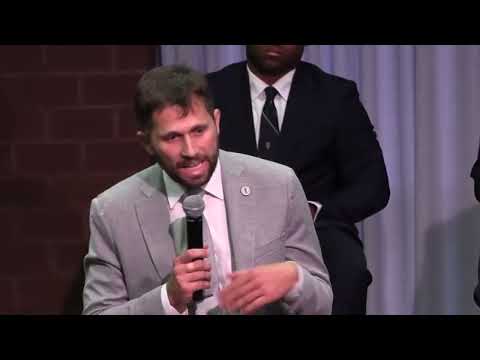
Good evening, Barry Beecham, county resident.
And as far as the, I guess the elephant in the room here, everybody's talking about,
you know, we need funds, and the funds, or lack thereof, I'd say the elephant in the
room is the tax cap.
And I'm just curious, how many people here would be willing to have their taxes, their
property taxes raised to support any profit, because, and that's, that's really what we
need to really look at, and you know, for me to say, hey, I'm in favor, you know, of
a tax increase, I'm really, no one wants to hear that, but the problem is that we don't
have enough money.
And then you had an organization like the Greater Salisbury Committee, okay.
Greater Salisbury Committee has fought for years to try to change or get rid of the revenue
cap.
This county executive who has talked about the elephant in the room, that all by itself
deserves applause.
Thank you for that.
The elephant in the room, we have in our GSC 2030 plan, we address the revenue cap, and
all we ask for is that a blue ribbon panel, just like the one that we've assembled to
come and talk to you tonight, made up of community leaders, takes a look at that public policy
that was implemented more than 20 years ago and simply ask the community, is this still
appropriate public policy?
It's giving me the perception that we're only looking at using property taxes to solve our
problem and yet we have completely bypassed the income tax, which is larger than our property
tax revenues, and I know that the income tax receipts, I believe, are supposed to be increasing
this year as well, despite the economic conditions.
In fact, I guess it's been about eight or ten years ago, they put a committee together
to study the revenue cap.
What can we do to change this revenue cap?
So I went to this meeting one day and one of the person that was in charge of the meeting
said, "We need to change this revenue cap because if we have a hurricane, tornado, or
a natural disaster, we might have to raise taxes."
So my question is to him, I said, "So let me ask you this, somebody's house blows down,
you want to raise their taxes?"
So then they had this committee chairman get up and he gave his spiel and I asked him,
I said, "You know, medium income, personal income in Wicomico County is about maybe $50,000
or $60,000, I don't remember what it was back then."
I said, "How many people on your committee is in that income range?"
Because this club charges $2,500 a year to be a member of.
The Greater Salisbury Committee.
And he had to say, "No, nobody."
There was a bunch of multimillionaires, millionaires on this committee wanting to raise taxes for
the other folks in the county.
They could probably afford it.
Maybe some other folks couldn't.
When all this started back with the revenue cap, do you have any idea, recollection, or
anything of the general area of the county budget was at that point in time?
I mean, how much money was the county spending per year?
Okay, from 1867, people laugh at me when I bring this 1867 thing up, but that's when
Wicomico County came into being.
From 1867 to 2006, our budget went from nothing, I guess, in 1867, to $104 million.
Okay, so in 2006, our budget was $104 million.
This last budget we passed was $234 million.
So $130 million more in 20 years with a revenue cap.
So let me ask you a question.
What's wrong with a revenue cap?
Now our income, now people's going to look at this and say, "Well, wait a minute.
We got a revenue cap, but our taxes keep going up."
Okay, our taxes are going up because of assessments.
That's why our tax is going up.
We've lowered the tax rate, I think, in 2006, it was something like $1.98 or something like
that.
Now it's down to $77, somewhere in that range.
My taxes keep going up, but we have a revenue cap.
Okay, well, that's because of assessments.
Now if we didn't-
They would have gone up.
They would have gone up.
Yeah, I think somebody made the comment, I don't know if it was one of the county executives
or somebody from our staff said, "It would only be $300 or $400 a year on your taxes."
Well, that might be one year.
What about the next year and the next year?
So protecting the revenue cap's been high on my list of things to do, and it's helped
us do several things.
We've built new schools.
We have had roads repaired.
You have to fuss to get that done.
You have to raise gain to get somebody to fix a road, and we've also had a healthy savings
out of that, which helps when we go to build schools because we get a better interest rate.
So for those that oppose the revenue cap or would like to eliminate it, where would the
extra funds be utilized?
Why are they opposed to the revenue cap?
Let's talk about where they're going to come from first.
They're going to come from your pocket, my pocket, your pocket, and the citizens out
there's pockets, and where would they be used?
Government can spend all the money they get.
It's not hard to spend money, and I think anybody in government can ... Somebody can
point to anybody in government and say, "Well, you're guilty of this, and you're guilty
of that."
I'm sure there's things I've voted on that people said, "Why did you do that?"
But they put me there to do that, I think.
Okay.
So is this when I hear the statement made that the taxes have been reduced in Wicomico
County?
Is this specifically what they're talking, referring to, the revenue cap?
Yeah.
They're referring to the tax rate, but the misconception that continues to be put out
there is that a politician will say, "I have lowered your tax rate."
I have heard that, and I'm not quite sure how that relates.
The politician has not lowered your tax rate.
The charter amendment, which put in the revenue cap, has lowered your tax rate.
And that's when we say, "We've lowered the tax rate," because the revenue cap demands
that we do it.
Yes.
It's in the law.
It's not required.
Joe Holloway didn't do it.
None of the other county executives who brags about doing it didn't do it.
Every county executive can say that I've lowered your taxes since revenue cap came in, because
of revenue cap.
As long as the county continues to grow, and you have hit the mid 30% of the revenue for
the county comes from income tax, and 30 some percent of it comes from property tax, you've
almost got 70% of your county budget coming from those two taxes.
And as long as those taxes keep increasing, the way the revenue cap is set, your property
rate will continue to drop in the county.
But at the same time, as Councilman Holloway stated, on the other hand, you have the state
coming down here and doing assessments, and raising your assessments.
So your property tax is going up, but it's not going up at the rate it would if the revenue
cap was not there to keep it from happening.
You know, one of the interesting things that I've seen is, and I think we brought this
up a few minutes ago, is you get people that run on a conservative platform.
The first thing they come out with is, "Our problem in Wacomico County is the revenue
cap."
Well, how do you stand out here and ask people to vote for you and say, "I'm a conservative,"
and then turn around and say that in a public forum?
Good evening.
I'm Larry Beecham, county resident.
And as far as the, I guess the elephant in the room here, everybody's talking about,
you know, we need funds.
And the funds, lack thereof, I'd say the elephant in the room is the tax cap.
So the outcome would be, you're actually, the individuals, the citizens, would end up
paying more tax?
Oh, yeah.
Oh, yeah.
Yeah.
That's definitely.
Yeah.
Well, another interesting thing about that is the state passed a law, and one of our
former delegates got this done, to where we can actually, the county can actually override
the revenue cap for just education.
Now, the bad part about that is, some delegate that comes out and makes a statement about
the revenue cap is bad for the county, could also put a bill in to say, "You can override
the revenue cap for something else, or something else," until basically, revenue cap is no
longer valid.
Yes.
Well, I think one of the feathers I'll stick in your cap is, as a district two person,
we held a, had a town hall held at Mardella, concerning the intercession of Old Railroad
at Route 50.
I know.
And Councilman Holloway came over, not his district, it's not his side of the county,
but he came over to listen and be involved in it, and the state highway basically said
that they were going to change the intercession, so you're going to have to make a right-hand
turn, go up, make a U-turn, and come back and do all this other stuff, and the citizens
in the town hall weren't really in favor of that.
The state highway was basically saying, "Well, this is what the engineers, surveyors, and
everybody have come up with," and Joe sat there and told the people that night, "You
don't have to accept this.
We had the same situation at 60-foot road, and they wanted to do the same thing down
there, and the people didn't want it, and you don't have to accept that."
Well, just a couple months ago, we had a traffic light installed at Old Railroad Road the way
that the community wanted it, not the way the state highway wanted to do it, which looked
like it was a problem, so you've got an example of a councilman that, not just in his district,
he's representing the county, and given his knowledge from past experience, that helped.
Well, that's ideal.
The back story on that is when they got ready to do the traffic light in Pittsville, they
were going to do the same thing.
They were going to do a turnaround instead of a traffic light, so we had a couple meetings
at the Pittsville Fire Department, and Donnie Drewer was the state engineer at the time.
For years, I'm talking years, I crossed Forest Grove Road at 50, going back and forth to
the store.
So, I was used to how the traffic flowed.
Now, they'd put a wall traffic light in a few years earlier at Wollaston Switch Road,
so if you were crossing 50, the eastbound lane, you would get that break from that traffic
light on Wollaston Switch Road.
You get that break, so you get across, like on the weekends, Sunday afternoons, when people
are leaving Ocean City, you couldn't get that break.
So I stood up at that meeting, and I said to Mr. Drewer, I said, "Mr. Drewer, it really
makes other intersections safer when you have a light at an intersection, because it'll
give people a break."
Well, they took that advice, and the next meeting we had, he made the comment.
He said, "I want to thank Mr. Holloway for his comments."
He said, "That really helped us in our decision."
You've talked about your successes.
Is there anything that you've been disappointed of?
Oh, yeah.
Oh, my gosh, yeah.
You know, when you lose a vote, you're disappointed, right?
Yeah.
But, a couple things.
I was really disappointed in the Ross Building, in the tax breaks that the Ross Building got.
I mean, the people that were building it were out here advertising, "Invest with us, we'll
promise you such and such," I think it was 8% or 10% return on your money.
But yet, the county gave them one heck ... I can't think of the number right off the top
of my head, but one heck of a tax break that goes on for a few years.
The city, I mean, they did free water and sewer to them.
They went in there, unbelievable, compared to what other people were having to pay.
The other thing I got criticized strongly for is I voted against the parking lot at
Civic Center across the street.
Okay, I voted against that, and the reason I voted, and I went to council members and
asked them about it.
Nobody was interested.
We should have bought the whole property.
We've got a school next to them that's going to need replacing sometime, and there's not
enough room to replace that school on that property unless you buy other properties close.
We should have really bought that whole mall lot instead of just that little part on the
corner.
In the last few months, I mean, when you had the Board of Education come in and do their
quarterly review with you on the council, Dr. Salfer mentioned that why middle school,
which they want to keep in the vicinity ... I mean, the property where it's at now is not
big enough to do what it needs to be done, but that they would need a 30-acre lot to
build that school.
Well, you're going to have a hard time finding a 30-acre lot in the vicinity of Salisbury
in that area.
I didn't go to school, and so it's just ... People don't look down the road.
They look ... When you're driving a car, you're not supposed to look over your hood.
You're supposed to look down the road, and that's what I think happens a lot in government.
They're looking at their hood, and they need to be looking down the road to see what's
coming.
I guess one of the saddest disappointments I've had is on the personal attacks that some
people use on council members.
We're all cut from a different cloth.
There's seven of us up there.
We all have different thoughts, different ideas.
We're all elected to serve everybody in Wacomico County, not just the people in your district,
but the personal attacks weighed on the council from the executive side of the government,
I think, has been very disappointing.
Somebody will say, "Well, the council said things, too."
You've got to.
You can't just sit there and take it.
You've got to react.
I think the biggest difference in that, and you're right, you have to react and reply,
but I think the biggest difference is the council is making their comments in council
meetings in front of people.
The other side is making their comments through social media posts, different shows, and then
different things, and doesn't involve their self in the council meeting.
Come in, have that discussion in the council meeting.
You don't have to have these discussions outside and throw all this dirt in from every other
direction.
Come in there, be a part of it.
Let's get it worked out in there in an open room.
Now, if I make a comment at the council meeting, it's on the record, and the next meeting,
those people that don't agree with me has that opportunity, can come back and say something.
I think that's another disappointing thing about ... I'll tell you what.
What that does, that makes people reluctant to run for public office.
It really does.
In some cases, somebody might say, "I don't want to subject myself to that or my family
to that."
It's quite apparent.
I mean, even if you look at the people who are running for council.
This term, there was one district that after filing deadline was up, a political party
had to go out and find somebody to run because nobody else ran.
There was another district that had two candidates, but they were both from the same party, so
the other side wasn't in it.
You have a Wacomico County school board district that nobody wanted.
So now, on the ballot, you have a right-hand candidate for that position.
Thankfully, somebody finally stepped up, but you're looking at a school board.
You can't even get somebody to represent the children in the county because exactly what
you say is, "Is it worth it?
Is it worth it?"
The personal attacks is really ... I mean, anyway.
Well, yes, there's coarsening of the culture over time is really disappointing.
I notice at the city level, for example, at their city, at Salisbury City Council meetings,
the mayor attends, and he's subjected to harsh statements, but I think he understands that
it goes with the territory, and he's generally in attendance.
You better have broad shoulders now if you want to be an elected official.
That's for sure.
You better be willing to take the grief, I call it, when somebody gives you a hard time
over it.
So thank you, Joe, Mr. Holloway, for joining us for this segment of-
Thank you for what you all do.
This is great.
Thank you.
Thank you.
Thank you, Jim, for joining us with your comments.
Sure.
It's good to pick Joe's brain.
I want to thank both of you for attending our council meetings and being involved.
Well, gentlemen, thank you so much for joining us for this episode of Open Agenda, and to
our audience, please join us again for the next episode.
What?
I'm not special?